About the Project
Integrating Digital Case-Based Learning to Enhance Clinical Reasoning in Community Medicine
A FAIMER fellowship project that reimagines how MBBS students build applied clinical reasoning — connecting the individual patient to the health of the community.
About CaseStep
CaseStep is a digital case-based learning platform that strengthens clinical reasoning in undergraduate Community Medicine. Through branching patient journeys, Script Concordance Testing, and OSCE/OSPE practice, it teaches students to reason the way clinicians actually do — under uncertainty, with incomplete information, and with the health of the community in view.
Founder & Academic Lead
Dr. D. Sunil Kumar — MBBS, MD (Community Medicine), PhD, MBA (Healthcare Management) — is Professor of Community Medicine at JSS Medical College and Dean (Students’ Welfare) at JSS Academy of Higher Education & Research, Mysuru. A medical educator, public health academic, and digital health innovator, he conceived, designed, and developed CaseStep, and leads its academic direction, case authorship, and research programme.
How CaseStep was built
CaseStep was conceived, designed, and developed by Dr. Kumar as an independent academic initiative, built from the ground up on established curriculum-design and assessment frameworks — Kern’s six-step approach, ADDIE, TPACK, Script Concordance methodology, and constructive alignment with India’s NMC CBME competencies.
The platform was developed during Dr. Kumar’s International FAIMER Fellowship in Health Professions Education, whose mentorship, scholarly community, and structured reflection shaped its educational design. The fellowship provided professional-development context; the platform itself is independently created and maintained.
Institutional names on this site indicate the creator’s professional affiliations and the ethical-review context of associated research; CaseStep is an independent academic platform and does not represent an official product of any institution.
Cite this platform: Kumar DS. CaseStep: a digital case-based learning platform for clinical reasoning in Community Medicine [Internet]. Mysuru; 2026. Available from: https://casestep.in
Background & rationale
Community Medicine equips future doctors to prevent disease and promote health at individual and population level. Yet much undergraduate teaching remains fact-heavy and didactic, and students often struggle to apply knowledge to real, uncertain clinical situations. Clinical reasoning — the cognitive process of gathering, interpreting and acting on information — is central to competent practice but is difficult to teach through lectures alone.
Digital Case-Based Learning offers a scalable, engaging way to practise reasoning repeatedly and safely. Interactive branching cases, script-concordance items and structured feedback let students rehearse the judgement clinicians use every day, while embedding the public-health lens that defines Community Medicine.
Problem statement
There is a need to strengthen applied clinical reasoning in Community Medicine, moving beyond knowledge recall to competent, context-aware decision-making that integrates clinical and community perspectives — in a form that is engaging, standardised, and measurable.
Project objectives
- Develop and validate digital case-based learning (DCBL) modules in Community Medicine aligned with NMC CBME competencies.
- Enhance students’ applied clinical reasoning through branching cases and script-concordance reasoning.
- Integrate community-diagnosis and public-health perspectives into individual clinical cases.
- Assess competence using OSCE/OSPE stations with structured checklists and global rating scales.
- Evaluate the educational impact using a mixed-methods, implementation-science-informed design.
Expected outcomes
- Improved clinical-reasoning scores (case decisions and SCT concordance).
- Higher student engagement and self-reported confidence in applied reasoning.
- A validated, reusable bank of digital cases and assessment stations.
- Faculty capacity to author and facilitate digital cases.
- Evidence for scale-up and publication in medical-education literature.
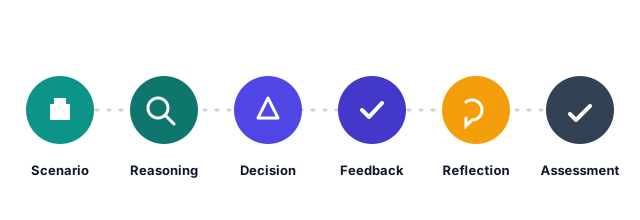
The clinical reasoning pathway
Every module — case, SCT item, or OSCE/OSPE station — rehearses the same underlying pathway.
Curriculum development frameworks
1. Problem identification & general needs
Gap in applied clinical reasoning within Community Medicine teaching.
2. Targeted needs assessment
Survey students and faculty; map NMC CBME competencies.
3. Goals & objectives
Define competency-linked reasoning outcomes for each case.
4. Educational strategies
Digital branching cases, SCT, OSCE/OSPE, reflection.
5. Implementation
Pilot within the Community Medicine posting and skills lab.
6. Evaluation & feedback
Mixed-methods evaluation feeding iterative improvement.
Analyse
Learner and curriculum analysis; competency mapping.
Design
Case blueprint, decision trees, assessment rubrics.
Develop
Author digital cases, SCT items, OSCE stations.
Implement
Deploy platform; run guided and self-directed sessions.
Evaluate
Formative and summative evaluation; iterate.
NMC CBME domain alignment
How each competency domain is addressed by the platform's activities.
| Domain | How CaseStep addresses it |
|---|---|
| Knowledge | Case investigations, differential reasoning, and management steps rehearse applied biomedical and public-health knowledge, not recall alone. |
| Skill | OSCE/OSPE stations assess hands-on and interpretive skills (BP measurement, foot-risk screening, growth-chart interpretation) with weighted checklists. |
| Communication | Counseling steps within cases and OSCE stations explicitly assess patient communication and shared understanding. |
| Professionalism | Reflection prompts after each case cultivate self-awareness, humility about uncertainty, and a public-health orientation to individual care. |
TPACK — technology in service of pedagogy and content
A branching digital-case engine, instant formative feedback, and analytics dashboards — chosen because they enable rehearsal and feedback at a scale lectures cannot.
Case-based learning, script-concordance theory, and constructive alignment (competency → activity → assessment) drive the design, not the tool.
NMC CBME Community Medicine competencies — NCDs, MCH, communicable disease, emergencies, occupational/environmental health — authored by a subject-matter specialist.
FAIMER project logic
How the fellowship structure translates into this platform, end to end.
Fellowship
International FAIMER Fellowship: structured mentorship and peer review.
Needs assessment
Identify the applied-reasoning gap in Community Medicine teaching.
Curriculum innovation
Design and build digital case-based learning, SCT, and OSCE/OSPE modules.
Evaluation
Pilot, evaluate, and iterate using a mixed-methods design.
Dissemination
Share outcomes with FAIMER, the institution, and the wider medical-education community.
Constructive alignment
Competency, learning activity, assessment, and evidence are deliberately linked for every module — illustrative examples below.
| Competency | Learning activity | Assessment | Evidence collected |
|---|---|---|---|
| Diagnose & manage Type 2 Diabetes (CM 3.4) | Type 2 Diabetes digital case — branching decisions on diagnosis and first-line therapy | In-case decision scoring + SCT item on diagnostic thresholds | Case-decision accuracy; SCT concordance score |
| Measure BP and counsel on hypertension (CM 3.4) | Hypertension case + BP-measurement OSCE station | Weighted OSCE checklist + global rating scale | OSCE station score; examiner global rating |
| Provide risk-stratified antenatal care (CM 9.x) | Antenatal Care case + danger-sign counseling OSCE station | Branching decisions + OSCE checklist on danger-sign counseling | Case completion; OSCE checklist score |
| Investigate an outbreak (CM 8.x) | Vector-borne outbreak-investigation case | Decision points on case definition and control measures | Case-decision accuracy; reflection quality |