Skip to content
International FAIMER Fellowship Project

Enhancing Clinical Reasoning in Community Medicine

CaseStep is a digital case-based learning platform designed to strengthen clinical reasoning in undergraduate Community Medicine — through structured scenarios, branching decisions, reflective prompts, Script Concordance Testing, OSCE/OSPE practice, and faculty analytics.

11
Case topics
5
SCT modules
4
OSCE/OSPE stations
Case PreviewDecision point 2 of 4

The Tired Shopkeeper — Type 2 Diabetes

FPG 156 mg/dL, HbA1c 8.9%, non-healing foot ulcer. What is your next step?

Confirm diagnosis & screen for complications
Start insulin immediately
Reassure and review in 3 months

Correct. Confirm the biochemical diagnosis and screen for early complications before treating.

What is Digital Case-Based Learning?

Digital Case-Based Learning (DCBL) presents authentic patient problems as interactive, branching journeys. Instead of memorising facts, students practise the reasoning clinicians actually use — generating hypotheses, weighing evidence, deciding under uncertainty, and connecting the individual patient to the health of the community.

Read the rationale

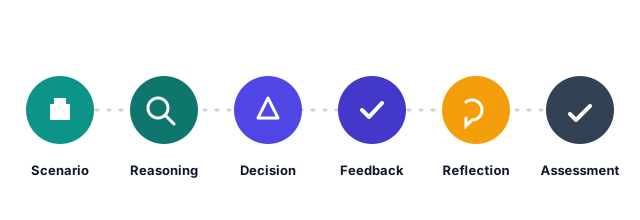
The stepwise learning journey

Every case follows the same evidence-informed path, from first encounter to consolidated reflection.

  1. 1

    Scenario

    Meet a realistic Community Medicine patient.

  2. 2

    Reasoning

    Work through history, exam, and investigations.

  3. 3

    Decision

    Make a branching clinical decision.

  4. 4

    Feedback

    Get immediate, reasoned feedback.

  5. 5

    Reflection

    Reflect and add the community lens.

  6. 6

    Assessment

    Consolidate via SCT and OSCE/OSPE.

Featured cases

Fully authored, ready-to-play clinical journeys.

Intermediate
25 min

The Tired Shopkeeper — Type 2 Diabetes Mellitus

A 48-year-old shopkeeper with fatigue and polyuria. Build a stepwise diagnosis, risk-stratify, and design community-level management.

Competency: CM 3.4 / IM 3.x
Reasoning focus: Hypothesis generation from vague symptoms, threshold-based diagnosis, and translating individual care into population screening.
NCDScreeningChronic careCounseling
Intermediate
22 min

The Silent Pressure — Essential Hypertension

A 55-year-old teacher with an incidental high BP reading. Practise correct measurement, staging, risk assessment, and stepped management.

Competency: CM 3.4 / IM 1.x
Reasoning focus: Distinguishing true hypertension from measurement artefact/white-coat effect, cardiovascular risk stratification, and stepped pharmacological reasoning.
NCDScreeningCVD riskCounseling
Foundation
24 min

The First Visit — Antenatal Care

A 24-year-old primigravida at 12 weeks. Deliver risk-stratified antenatal care, recognise danger signs, and apply the community MCH package.

Competency: CM 9.x / OG 2.x
Reasoning focus: Risk stratification of pregnancy, recognition of danger signs, and integrating preventive/promotive care with the national MCH programme.
MCHPreventiveScreeningCounseling

Built to be shown, not just used

CaseStep is designed to withstand scrutiny from FAIMER mentors, curriculum reviewers, and journal editors — not just to demo well.

Academically grounded

Every module is deliberately mapped to Kern’s 6-step model, ADDIE, TPACK, and NMC CBME competencies — not retrofitted after the fact.

Reasoning-focused, not recall-focused

Branching decisions, Script Concordance items, and OSCE/OSPE stations are designed to assess applied judgement under uncertainty.

Honest by design

All cohort analytics, expert consensus, and demo progress are clearly labelled illustrative data until an ethics-approved deployment generates real results.

Grounded in established frameworks

CaseStep is designed as a serious educational innovation, aligned with curriculum, assessment, and research frameworks recognised by medical educators.

NMC CBME CurriculumFAIMER Project FrameworkKern’s 6-Step ModelADDIE ModelTPACK FrameworkClinical ReasoningScript Concordance TestingOSCE / OSPE AssessmentMixed-Methods ResearchImplementation Science

See the platform in one sitting

A single case, one SCT module, and the faculty dashboard are enough to show the whole idea.